
Search just split in two. One half sends people to a list of links. The other half hands them a finished answer. If your content only knows how to win the first game, you are already losing the second one.
SEO gets your page ranked in search results. GEO gets your information selected and quoted inside AI answers from tools like ChatGPT, Perplexity, and Google AI Overviews. They share a foundation, but they reward different things.
A page can sit at position one on Google and still get skipped by an AI Overview. Ranking and getting cited are not the same win. This guide covers the difference of GEO vs SEO and how they actually work.
What Is Search Engine Optimization?
Search engine optimization shapes a website so search engines like Google and Bing rank it higher for relevant queries. It rests on a few pillars.
Technical SEO covers crawlability, indexing, site speed, and Core Web Vitals. On-page SEO covers keyword placement, headings, and content quality.
Off-page SEO covers backlinks and brand mentions elsewhere on the web. Local SEO adds a layer for businesses serving a specific area, built around a Google Business Profile and NAP consistency.
An SEO agency usually starts with an SEO audit. It checks site architecture and internal linking before touching a single page. Fixing content on a site Google cannot crawl is wasted effort.
SEO has run the show for two decades. It is not disappearing. It is just no longer the only game in town.
What Is Generative Engine Optimization?
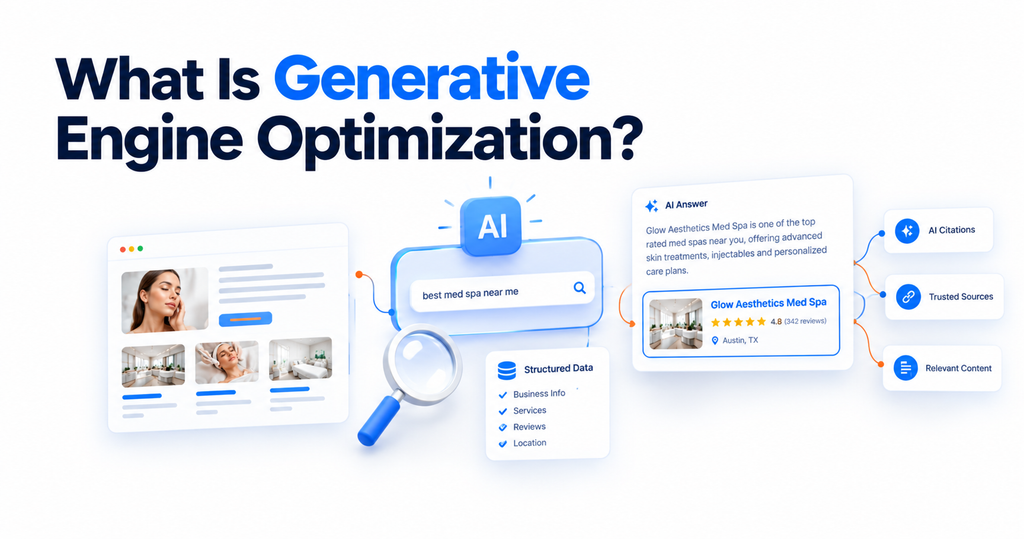
Generative engine optimization, or GEO, shapes content so AI systems can extract it, trust it, and cite it. Some call this answer engine optimization, or AEO. GEO does not rank pages the way Google does. There is no list of ten links to fight over. A language model reads across many sources and stitches the best facts into one answer.
That means the model needs to recognize your brand as a clear entity. “Scottsdale Plumbing Co. installs tankless water heaters” is a citable fact. “We’re basically the best in the business” is not. GEO succeeds when your content is the cleanest source a model can pull from. Not the loudest. The clearest.
Why Does GEO Matter Now?
Picture a homeowner in Chandler searching for a plumber at eleven at night. Ten years ago, she would scroll through results and pick a name. Today, she might ask an AI assistant instead, get one recommendation, and call that business directly. Fewer clicks happen before a decision gets made.
Google’s AI Overviews now appear on a majority of search pages. Multiple industry trackers put that figure above half of all Google searches in 2026. Businesses that ignore GEO are not losing traffic slowly. They are losing the exact moment a customer decides who to trust.
Does GEO Replace SEO?
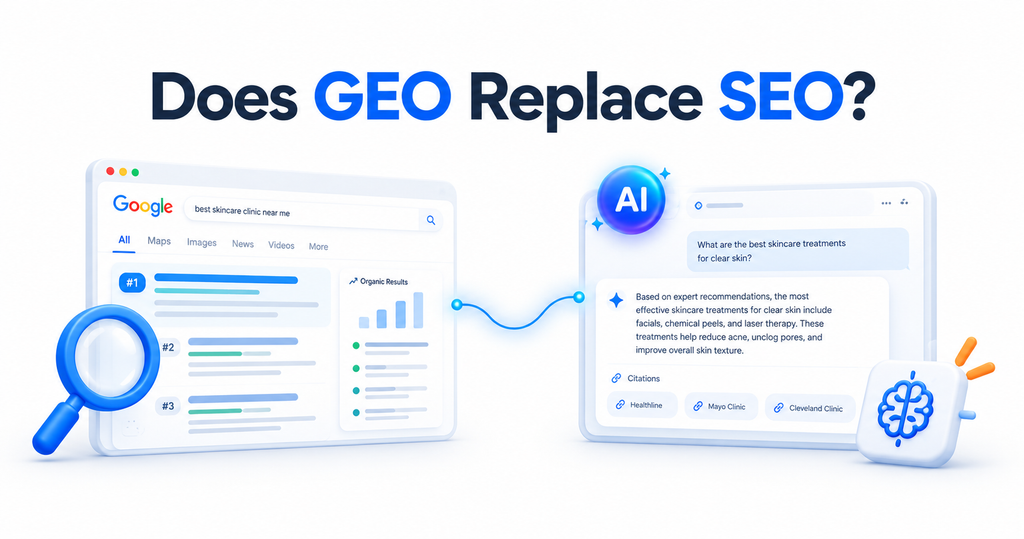
No. This question comes up constantly, and the answer stays the same. AI models depend on an indexed, structured web to pull from. If SEO disappeared tomorrow, generative engines would have nothing reliable left to cite. Poor content fails in both worlds. Thin pages with vague claims will not rank on Google, and they will not get quoted by an AI model either.
Clear structure helps both audiences too. Proper headings tell Google how a page is organized. They also help a model isolate a fact without losing context. E-E-A-T still matters to both systems. AI engines are arguably pickier about it, because a wrong citation damages the model’s credibility instantly.
So no, GEO will not replace SEO. But treating them as separate departments costs real visibility.
GEO vs SEO: Where They Diverge:
The overlap ends fast once you look at what each system rewards.
| Factor | SEO | GEO |
| Primary goal | Rank the page higher in search results | Get the information cited inside an AI answer |
| What gets optimized | The full page and its ranking position | Individual facts and their extractability |
| Authority signal | Backlinks, domain authority, keyword targeting | Entity clarity, cross-source consistency |
| Content structure | Layered subtopics built for engagement | Direct answers stated early, standing alone |
| Success metric | Rankings, organic traffic, click-through rate | Citation frequency, brand mentions, share of voice |
| User journey | Click the link, visit, convert | Read the answer, remember the brand, act later |
| Scope of control | Mostly your own website | Your website plus reviews, forums, third-party mentions |
One line explains the whole table. Google can forgive a hedge. An AI model usually cannot.
“Our platform is considered one of the leading options” might still rank. It gives no name to quote. “Our platform serves 40,000 small businesses across three countries” gives the model something concrete.
What GEO Means for Local Businesses and Local SEO:
This is the part almost nobody covers. It is exactly where local businesses have an opening.
Local SEO already trains businesses to think in specifics. A landscaper in Mesa lists an exact service area. A dentist in Tempe fills out a complete Google Business Profile. That habit of precision is exactly what GEO rewards too. AI assistants increasingly pull from the same local signals search engines already use. Clinics are a good example, as our guide to local SEO for medical aesthetic clinics shows.
A business with consistent NAP details, strong reviews, and clear service area pages gives a model exactly what it needs to answer confidently. Review management matters more here than owners realize. AI systems weigh third-party trust signals heavily, sometimes more than a business’s own website copy.
Arizona small businesses, from Phoenix to Tucson to Flagstaff, are competing where most local rivals have not touched GEO yet. That gap will not stay open forever.
How to Optimize Content for Both SEO and GEO:
You do not need two content strategies. You need one strategy built to satisfy both systems at once.
- Start with entity clarity. Replace vague phrases with specific names. Name the actual product, the actual source, the actual year.
- Structure for extraction next. Put the direct answer in the first sentence of every section. Save supporting detail for after.
- Answer full questions, not isolated keywords. Match how people actually talk when they search or ask a voice assistant.
- Add schema markup where it fits. Article schema, FAQ schema, and local business schema all give structure to both systems.
- Monitor how your brand gets described across the web, not just on your own site. Fix inaccurate mentions at the source. We build this into our aesthetic clinic SEO work, including AI search visibility.
Mistakes I See Businesses Make With GEO:
The most common mistake treats GEO like a checklist instead of a mindset shift.
A business adds an FAQ section and calls it done. Structure alone will not save vague writing. The answer still has to be clear.
The second mistake ignores third-party content entirely. One stale directory listing or unanswered negative review can misrepresent a brand, no matter how good the homepage is.
The third mistake chases keyword density instead of clarity. Stuffing a page with keyword variations does not help a model understand anything. It just hurts readability. These issues overlap with broader SEO mistakes that can weaken search visibility.
How to Measure GEO Performance:
SEO measurement is mature. Rankings, organic traffic, and conversion rate all have established tools behind them. GEO measurement is still catching up. Track brand mentions inside AI-generated responses and branded search trends in Google Analytics 4. The tools in our SEO tools for medspas guide make this tracking easier.
Traffic alone will not tell the full story anymore. Someone can see your brand in an AI answer, skip the click, then search for you by name weeks later.
Conclusion
SEO gets you discovered. GEO decides whether you get believed. Businesses that master both are not choosing between two trends. They stay visible while the rest scramble to catch up. The gap is open right now. Most local competitors have not touched GEO yet, which means the businesses that act first will be the ones AI tools quote when a customer asks who to call.
Not sure where your business stands? Request your free audit today. We review your search rankings, Google Business Profile, schema markup, and the way AI tools currently describe your brand, then send you a clear, prioritized list of fixes, with no jargon and no obligation.
FAQs:
Does GEO replace SEO?
No. GEO depends on the structured, indexed content SEO produces. Strong SEO remains the foundation for AI visibility.
Is GEO the same as AEO?
They overlap heavily. Most practitioners use the terms to describe the same goal, getting cited inside AI-generated answers.
What is generative engine optimization in simple terms?
It means writing content clearly enough that an AI model can pull out a fact and quote it accurately.
How do you measure GEO success?
Track citation frequency, brand mentions, share of voice against competitors, and lift in branded search volume.
Do I need a different content strategy for AI search than for Google?
No. One strategy works if it states answers early, backs claims with specifics, and stays consistent everywhere.


