
The best SEO tools for medspas in 2026 fall into five jobs. Keyword research, local visibility, technical health, content quality, and reputation tracking. Semrush and BrightLocal lead their categories. Google’s own free tools, Search Console and Business Profile, remain non negotiable no matter your budget.
A clinic owner in Scottsdale sent us her tool list last month. Fourteen subscriptions. Nine hundred dollars a month. She had never once opened the Google Search Console.
That’s the pattern we see constantly. Clinics buy tools the way they buy skincare products, more feels like progress. It rarely is. Here’s what nobody tells you about SEO tools for medspas. The tool does not rank you. What you do with it does.
This list highlights ten tools to consider buying or testing for free. It explains what each tool does and the key reason to subscribe. No fluff, no fourteen tab browser windows.
Why Generic SEO Tools Miss What Medspas Actually Need
Most SEO tool guides are written for businesses like coffee shops and law firms. Medspas are different. They face stricter YMYL rules, choosing the right Google Business Profile category is more important, and keyword research needs to consider search intent.
Someone searching for “Botox” is ready to learn about the treatment, while someone searching for “Botox recovery time” may already be considering the procedure.
A tool that ignores that distinction wastes your time. For clinics competing in Arizona, this also means building a strategy around the treatments, patients, and local competition in their market.
Scottsdale SEO for aesthetic clinics takes that treatment-specific approach rather than relying on generic SEO tactics.
How We Picked These Ten
Three filters. Real use in actual medspa campaigns, not theory. No overlap, each tool earns its spot by doing something the others cannot. And a price range that works whether you run one location or five.
If a tool did not clear all three, it did not make the list, no matter how popular it is on marketing Twitter.
Start with the tools that answer the most basic question first. What are patients actually typing into Google before they ever find your clinic.
Keyword Research Tools
1. Semrush
What it does. Semrush pulls keyword volume, competition data, and ranking positions for any domain, including your competitors.
How medspas should use it. Run your top three local competitors through the domain overview report. You will usually find they rank for treatment terms you have never written a single page about. That gap can reveal SEO mistakes in your own content strategy, especially when important treatments have no dedicated pages.
Practical tip. Filter for treatment and location phrases with booking intent. These SEO keyword research tips can help you choose relevant terms.
Semrush tells you what people search for right now. The next tool tells you when they start searching for it in the first place.
2. Google Trends
What it does. Google Trends shows search interest over time, completely free, for any term or comparison.
How medspas should use it. Check seasonal patterns before planning content. Body contouring searches climb every year starting in February, months before summer. Miss that window and you are writing the right content four months too late.
Practical tip. Compare two treatments directly, like “Botox vs filler,” to see which term patients actually search more. Write the comparison content around whichever term wins.
Knowing what to say only matters if patients can actually find you nearby when they search for it. That is where local visibility takes over.
Local Search Tools
3. Google Business Profile
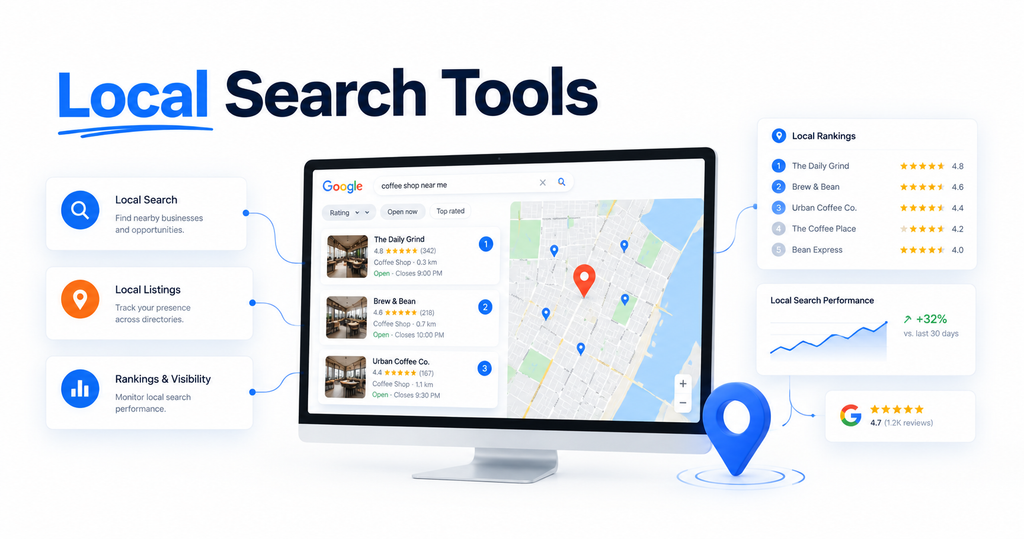
What it does. This is not really a tool, it is the platform. Your Business Profile controls how you show up in the Map Pack, the three listings shown above regular search results for local queries.
How medspas should use it. Treat it like a second website. List every treatment as an individual service. Post weekly. Answer every question in the Q&A section before a patient has to ask it.
Practical tip. Wrong category selection is the single most common mistake we see. A clinic listed under generic Health instead of Medical Spa stays invisible to the exact searches it should be winning, and nobody notices until rankings are checked. Start with accurate categories, services, and contact details.
Effective local SEO for medical aesthetic combines an accurate Business Profile, consistent citations, and genuine patient reviews.
Your profile is only as strong as the information backing it up across the rest of the internet. That is what the next tool checks.
4. BrightLocal
What it does. BrightLocal tracks your local rankings across multiple locations and audits your citations for inconsistencies.
How medspas should use it. Run a citation audit before doing anything else. One clinic we reviewed had three different suite numbers listed across Yelp, Healthgrades, and their own footer. That single inconsistency was quietly capping their entire local visibility.
Practical tip. Set up rank tracking for treatment plus city combinations specifically, not just your brand name. Brand name rankings tell you nothing about whether new patients can find you.
Rankings and citations mean little if the site underneath them is quietly broken. That is the next layer to check.
Technical SEO Tools
5. Google Search Console
What it does. Search Console shows exactly which queries bring people to your site, how your pages perform, and which pages Google cannot properly crawl.
How medspas should use it. Check the coverage report monthly. We have opened more than one clinic’s Search Console to find their robots.txt file quietly blocking Google from crawling half their treatment pages. Nobody had looked in over a year.
Practical tip. Sort the performance report by impressions with low clicks. Those are pages ranking on page one or two that need a stronger title tag, not a rewrite.
Search Console shows you the symptoms. The next tool finds the actual source of the problem.
6. Screaming Frog
What it does. Screaming Frog crawls your entire site the way Google does, flagging broken links, missing meta tags, and duplicate content in minutes.
How medspas should use it. Run a full crawl before any content push. Fixing a broken internal link structure first means new treatment pages actually get discovered and indexed instead of sitting orphaned. Visit our guide on common SEO mistakes that can quietly limit a clinic’s visibility.
Practical tip. Export the duplicate title tags report first. Clinics running five near identical location pages almost always find this is where their rankings are getting split instead of stacked.
Once the foundation is solid, the actual writing and images on the page start to matter a lot more.
Content Optimization Tools
7. Yoast SEO or RankMath
What it does. These WordPress plugins check your on page optimization in real time as you write, readability, keyword placement, and meta tag length.
How medspas should use it. Use the readability score as a guardrail, not gospel. Medical accuracy always wins over a perfect green checkmark. We would rather see an honest, slightly complex sentence about filler migration than a dumbed down one that skips the real risk.
Practical tip. Set your focus keyword to the exact treatment and location phrase, like “lip filler in Tempe,” not just “lip filler” alone.
Good writing still needs to load fast, and that usually comes down to the images sitting on the page next to it.
8. Canva Plus TinyPNG
What it does. Canva builds simple graphics and before and after templates. TinyPNG compresses those images without losing visible quality.
How medspas should use it. Compress every image before upload, always. A single uncompressed before and after gallery can add several seconds to your mobile load time, and mobile speed directly affects both rankings and whether a nervous patient sticks around to book.
Practical tip. Rename image files with the actual treatment name before uploading, like botox-forehead-results.jpg instead of IMG4821.jpg. Google reads file names, and so does your alt text.
None of this matters if you cannot see whether it actually turns into booked patients. That is the last piece of the puzzle.
Reputation and Analytics Tools
9. Google Analytics 4
What it does. GA4 tracks what actually happens after someone lands on your site, which pages they visit, where they drop off, and whether they ever hit your booking button.
How medspas should use it. Set up a conversion event specifically for booking form submissions and phone number clicks. Traffic without that data tells you almost nothing about revenue. The real goal is turning search visibility into more med spa leads and bookings.
Practical tip. Check your top landing pages by conversion rate, not by traffic volume. We have seen a page with a fraction of the visitors outperform the homepage on actual bookings, simply because it matched exact patient intent.
Booked patients still need to talk about the experience afterward, and that conversation happens in public.
10. Podium or Birdeye
What it does. Both platforms automate review requests and let you manage responses across Google, Yelp, and other platforms from one inbox.
How medspas should use it. Trigger the review request the same day as the appointment, while the result is still fresh and the patient is still glowing, literally.
Practical tip. Never script exact phrases for patients to include in reviews. It reads as fake because it often is, and platforms are increasingly good at spotting the pattern. Ask for honesty instead, and respond to every review, good or difficult, within 48 hours.
That covers the ten tools most clinics need today. One more is worth watching closely, even though it is still new.
Tracking Your AI Search Visibility
Here’s a section almost nobody covers yet, and it will matter more with every passing month. Patients now ask ChatGPT and Google’s AI Overviews “what’s the best treatment for under eye hollows” instead of typing a search query.
If your content is not being cited in those answers, you are losing a growing slice of patients who never even reach a traditional search results page.
A new category of tools built specifically to track AI citation visibility is starting to emerge, working the same way traditional rank trackers monitor your position in regular search results. These are still early, but worth testing if AI search already sends you meaningful traffic.
Our guide to generative engine optimization explains why these citations matter more every month.”
Can ChatGPT Do SEO?
ChatGPT can help draft content outlines, brainstorm keyword angles, and summarize what patients tend to ask. It cannot crawl your site, fix technical errors, or build your citation profile. Treat it as a fast research assistant, not a replacement for the tools above.
These ten tools are a real list, and not every clinic needs all of them on day one. Here is how to decide what actually fits your stage.
Building a Toolkit That Actually Fits Your Budget
Not every clinic needs the same stack. What you run in year one looks nothing like what a five location practice needs.
| Clinic Stage | Tools to Run | Monthly Budget |
| Solo practice, just opening | Google Business Profile, Search Console, GA4 | Free |
| Growing single location clinic | Add Semrush for keyword research and BrightLocal for citation tracking | 150 to 300 dollars |
| Multi location practice | Add Screaming Frog for technical checks and a reputation tool like Podium | 500 to 1,000+ dollars, scaling with location count |
If your current stack does not fit one of these three tiers cleanly, you are probably paying for overlap. That is money that should be going toward content or citations instead.
Need a strategy beyond SEO tools? Explore our Scottsdale SEO service for aesthetic clinics.
Do I Really Need Paid Tools, or Can I Just Use the Free Tools?
Free tools work fine at first. They hit a wall fast once you run more than one location or write more than a few pages a month. The real cost is not the subscription. It is the hours spent checking rankings by hand across cities, hours a paid tool handles overnight on its own.
Past a certain size, your time costs more than the tool does. There is one more thing worth knowing before you build your stack, and it has nothing to do with which software you pick.
Sometimes the problem is not which tools you own. It is whether you have the time to actually run them well.
When a Tool Cannot Fix the Real Problem
Sometimes every tool is set up right, and the numbers still will not move. That usually points to a different question.
Should I Hire a Marketing Agency for My Med Spa?
Tools handle the work. They do not replace strategy. If you have used these ten tools well for six months and rankings still sit flat, that is usually a strategy gap, not a tool gap. It is worth bringing in outside help.
Signs it is time. Your rankings have stalled despite steady effort, or you keep hearing different advice about which tool to trust next.
We built our own process around exactly this gap. Request a free SEO audit and we will show you exactly which of these tools your clinic actually needs, and which ones are wasting your budget.
How Do I Choose an SEO Company That Specializes in Healthcare and Clinics?
Ask for examples of healthcare work and an explanation of medical content review. Review the agency’s SEO case studies to understand its approach and results.
Any agency promising guaranteed rankings does not understand how Google actually works, and that is a red flag worth walking away from immediately. Our guide lists the eight warning signs you are about to hire the wrong SEO company.
Mistakes We See on Repeat
Buying five tools that do the same job, usually after a good sales call. Setting up Search Console once and never opening it again. Buying reputation software before fixing a booking form that quietly loses half its leads.
Chasing a shiny new AI visibility tool while your Google Business Profile sits unclaimed for two years.
Every one of these is fixable in an afternoon. None of them need a bigger budget, just a clearer list of what matters most.
Conclusion
None of these ten tools will rank your clinic by themselves. They hand you the data. What you do with that data, which keyword to chase, which category to fix, which review to answer, is still the actual work.
If sorting through that data feels like a second job you did not sign up for, that is exactly what we do for a living. Talk to our team about building a toolkit and strategy that fits your clinic, not a generic small business template with your city name swapped in.
Frequently Asked Questions
Is SEO really worth it for small plastic surgery clinics?
Yes, often more than for bigger practices. Local search rewards steady, correct work over size, not brand recognition. A single location clinic with a complete Google Business Profile can outrank a five location chain that never updated its listings.
Do I need all ten tools, or can I start with fewer?
Start with the four free tools. A solo practice just opening rarely needs more than Google Business Profile, Search Console, and GA4 in the first six months. Add Semrush and BrightLocal once a content and review process is running.
What is the most affordable SEO tool?
Google Search Console. It is completely free and shows exactly which searches bring people to your site. Checking it monthly often reveals pages already ranking on page two that just need a stronger title tag.
How do I get clients for a med spa?
Claim your Google Business Profile, collect honest reviews, and publish content around real patient questions. These three basics, done consistently, bring in more new patients than most paid campaigns.
.


