
A dentist in Ohio told us something last winter that stuck with us. He had the newest equipment in his city. Five star reviews. A genuinely great team. Yet a practice two miles away, open less than two years, kept beating him for every “emergency dentist” search in town.
We pulled up both websites. His competitor had done nothing fancy. Just the basics, done completely, month after month. That gap is what this guide is about.
SEO for dentists means improving your website and Google Business Profile, managing online reviews, and helping patients find your practice when they search for a dentist nearby.
It works through five parts, on page content, technical setup, local listings, trust signals, and AI search readiness. Practices that handle all five consistently outrank ones that only handle one or two.
Why Do Many Dental Practices Struggle With SEO?
Here’s the honest answer. Most practices do not fail at SEO because it is complicated. They fail because the basics feel boring, so nobody finishes them.
A missing category on a Google profile. A treatment page written once in 2019 and never touched again. None of these look urgent on their own. Stacked together over a few years, they quietly bury a great practice on page two.
Many of these problems are common across healthcare SEO. Our guide to common SEO mistakes explains several issues that can prevent a website from reaching its full search potential.
What Is Dental SEO in Simple Terms?
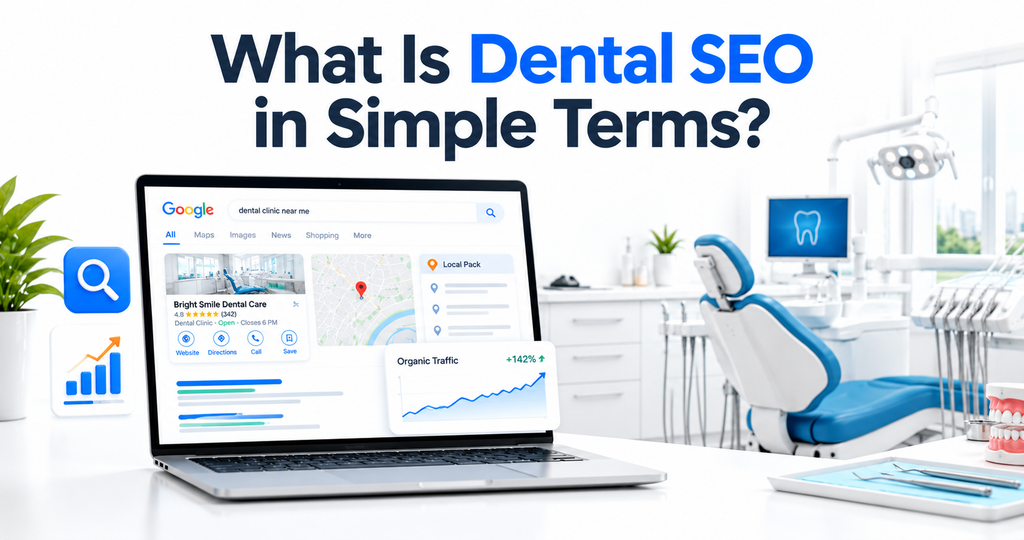
Dental SEO is the work of getting your practice to show up when someone searches for a dentist on Google, Google Maps, or an AI tool like ChatGPT.
It covers your website, your content, your local listings, and your reviews, all working together toward one outcome, a booked patient.
It is not the same as paid ads. Ads stop the moment you stop paying. SEO keeps working long after you publish a page, which is exactly why it compounds instead of resetting every month.
The Five Parts of a Real Dental SEO Strategy
Think of dental SEO as five separate jobs working together, not one single task.
- On-page is what lives on your website itself, your treatment pages, your writing, your structure.
- Technical is the invisible plumbing, your site speed and mobile experience.
- Local is your Google Business Profile, citations, and map ranking.
- Trust signals are your credentials and reviews, the things that convince both Google and a nervous patient you are legitimate.
- AI search is the newest piece, making sure ChatGPT and Google’s AI Overviews can actually find and quote your practice.
Miss one of these five, and the other four can only carry you so far.
Why SEO Actually Matters for a Dental Practice
Here’s a number worth sitting with. Federal health survey data has consistently found that roughly two thirds of American adults saw a dentist within the past year.
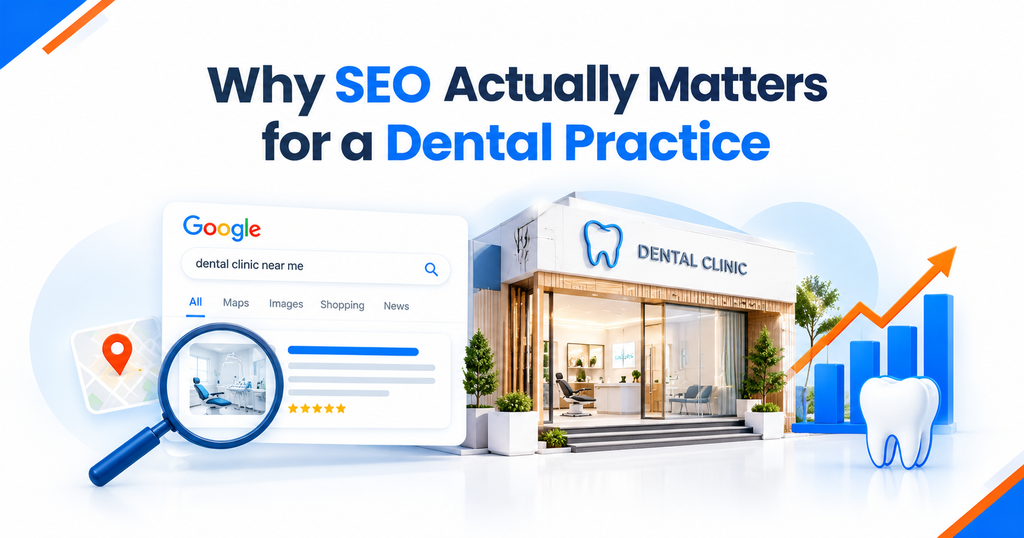
That is a massive, steady pool of people actively searching for care, and most of them start that search on Google.
When someone searches for “dentist near me,” they are not browsing. They already decided they need an appointment.
Ranking in the top three map results puts your practice directly in front of that decision, right at the moment it is being made.
What Are the Most Important Local SEO Ranking Factors for Dentists?
Search engines weigh two different sets of signals when deciding who ranks. Understanding both changes how you prioritize your time.
On-Site Ranking Factors
This covers everything Google can see directly on your website. The words on your pages. Whether your keywords show up naturally in your headers and titles. How fast your pages load. Whether your site works cleanly on a phone. How long people actually stay once they land on a page.
Off-Site Ranking Factors
This covers what the rest of the internet says about you. How many other sites link to yours. How consistent your business information stays across every directory. How many reviews you have, and how recent they are. Off-site signals are harder to fake, which is exactly why Google leans on them so heavily.
Dental searches are often dominated by big directory sites like Healthgrades and Zocdoc. Beating them organically is genuinely hard, which makes your off-site work even more important, not less.
Finding the Right Dental SEO Keywords
Here’s what nobody tells beginners about keyword research. The goal is not finding the most searched term. It is finding the term a ready-to-book patient actually types.
A thousand monthly searches for “what is a root canal” means far less than fifty searches for “emergency root canal near me.” One is someone learning. The other is someone in pain, ready to call right now.
Start with a free tool like Google’s own Keyword Planner. Check what your top local competitors already rank for. List every service you actually offer, then match each one to the way a real patient would phrase it, not the clinical term on your diploma.
Building Your Website’s SEO Foundation
Your website carries the weight of everything else in this guide. Get the foundation wrong, and no amount of content fixes it.
Technical Basics That Actually Move Rankings
Site speed matters more than most owners realize. A page that takes over three seconds to load loses a real share of mobile visitors before they read a single word.
Google’s own Core Web Vitals report tracks this directly inside Search Console, and it is worth checking every few months, not just once at launch.
Mobile first indexing means Google evaluates your mobile site as the primary version of your practice, not your desktop site. If your mobile experience is clunky, that is the version Google judges you on.
Writing Treatment Pages Patients Actually Trust
Give every real service its own page. Invisalign gets a page. Root canals get a page. A vague “Our Services” page trying to rank for a dozen treatments at once usually ranks well for none of them.
Each page should answer what a nervous first-time patient actually wonders. What does the treatment involve? What does recovery feel like? What does it typically cost? Skip the page and a patient fills that gap with a competitor’s answer instead.
Each major dental service should have its own dedicated page, with clear titles, headings, content, and internal links. These are core on-page SEO strategies that help search engines understand what each page should rank for.
Adding Schema Markup That Names the Right Types
Schema is code that tells Google exactly what your business is, in a format machines read cleanly. Most dental guides mention schema vaguely. Here is what to actually add. LocalBusiness schema for your core details.
Dentist schema for your practice type. Service schema for each treatment. FAQPage schema on any page answering common patient questions.
This single technical step gives both Google and AI tools a clean, verifiable source to pull from.
How Do I Know If My Dental SEO Is Working?
Track conversions first, calls, form submissions, and booked appointments, not just traffic. Traffic without bookings tells you almost nothing about revenue.
Check your keyword rankings monthly in Search Console, and keep an eye on whether your review count is climbing steadily instead of sitting flat.
Want to see how SEO performance translates into measurable business results? Explore RankSeoly’s SEO case studies for examples across different industries.
A Local SEO Guide for Dentists
For a dental practice, local SEO outweighs almost everything else on this list. Patients need to physically visit your practice, so showing up in local search and Google Maps matters enormously.
How Do I Rank in Google Maps as a Dentist?
Complete your Google Business Profile fully. Keep your business information identical everywhere it appears online. Collect reviews steadily, not in rushed bursts. Post updates weekly. Practices that do all four consistently tend to beat practices doing one or two of them well.
Google Business Profile Checklist
Claim and verify your listing first. Choose the most specific category available, “Dentist” instead of a generic “Health” category. Add every real secondary category and service you offer. Upload real photos monthly, not just your logo from launch day. Answer every review within a couple of days, the glowing ones and the frustrating ones alike.
Local Citations and NAP Consistency
NAP stands for name, address, and phone number. It needs to match exactly across Google, your own website, Healthgrades, Yelp, and every insurance directory you appear on. Even something as small as “Suite 100” on one listing and “#100” on another can quietly confuse Google about whether these are really the same practice.
Dental practices can also learn from local healthcare optimization. Our guide to local SEO for medical aesthetic clinics explains how healthcare businesses can improve their local search visibility.
How Do I Manage Local SEO for a Multi-Location Dental Practice?
Each location needs its own complete Google Business Profile and its own dedicated page on your website, never one shared page trying to represent every office at once.
Keep your branding consistent across locations, but let the actual page content stay specific, real staff, real address, real hours for that exact office.
Building Trust Patients and Google Both Reward
Showing Real Credentials and Experience
Attach a real name and license to your team and treatment pages. A short, honest bio does more for trust than any stock photo ever will. Google increasingly rewards content that clearly comes from a real, qualified person, not an anonymous page nobody stands behind.
How Many Google Reviews Does a Dental Practice Need?
There is no magic number, but momentum matters more than any single count. A practice with a hundred reviews averaging 4.8 stars earns far more trust, and far more clicks, than one sitting at fifteen reviews and a 4.0 average. Consistency over months beats a rushed push for a big number all at once.
Does E-E-A-T Really Matter for Dental Websites?
Yes, genuinely. Health content falls under what Google calls Your Money or Your Life, meaning it gets extra scrutiny for accuracy and trust. A page about a root canal written and reviewed by an actual dentist, with a name attached, holds up far better than an anonymous, unreviewed post covering the same topic.
Writing Content That HIPAA and Advertising Rules Actually Allow
Here’s a controversial opinion. Most dental blogs are written by nobody, reviewed by nobody, and both patients and Google can tell.
Before and after photos need real, documented patient consent. Claims about outcomes need to stay honest, since results vary person to person and overpromising can trigger real regulatory attention.
Build a simple consent and review process into your content workflow from the start. It protects your practice, and honestly, it is just the right way to treat a patient’s trust.
How Do You Optimize a Dental Website for AI Overviews and Voice Search?
Search does not look like it did even two years ago. Patients now ask an assistant directly instead of typing a normal query, and that shift is only accelerating.
What Is GEO and Why Does It Matter for Dentists?
GEO, or generative engine optimization, structures your content so AI tools like ChatGPT and Google’s AI Overviews can find, understand, trust, and cite your practice by name. Understanding how GEO and SEO work together can help dental practices prepare for this shift in search.
How Can My Dental Practice Show Up in AI Overviews?
Structure your content with short, direct answers near the top of each page. Add the schema types covered earlier. Keep your citations and NAP consistent everywhere, since AI systems weigh that consistency heavily when deciding who to trust enough to cite.
Dental SEO at a Glance
We built this table around how often each factor comes up in an actual practice audit, and how much visible ranking impact fixing it tends to have.
| Focus Area | What It Fixes | Fastest Action |
| Google Business Profile | Map pack visibility | Complete every field, verify your listing |
| Treatment pages | Weak rankings for specific services | One dedicated page per treatment |
| NAP consistency | Confused local rankings | Audit and correct every directory listing |
| Schema markup | Poor AI and Google understanding | Add LocalBusiness, Dentist, and FAQPage schema |
| Reviews | Low trust and click-through | Steady requests, fast responses |
| Site speed | Lost mobile visitors | Compress images, check Core Web Vitals |
Should Dentists Use Google Ads or Local SEO?
Both, ideally, but they solve different problems. Ads produce leads within days, which makes them the right tool for filling a slow month or promoting a new service fast.
SEO compounds slowly over months and keeps working long after you stop actively updating it.
Practices that rely on ads alone panic every time a campaign pauses. Practices with strong SEO underneath barely notice.
Can I Do Dental SEO Myself?
The basics, yes. Completing your Google Business Profile, requesting reviews, and writing clear treatment pages are all things a practice can handle in house with a checklist and a free afternoon.
Competitive markets, schema, and ongoing technical monitoring usually need a specialist to move the needle much further, but a wrong hire can cost you months, so learn the warning signs of a bad SEO company before you sign anything.
Conclusion
None of this requires a full website rebuild. Start with your Google Business Profile this week, since it is free and moves the fastest. Then give your top three treatments their own dedicated pages. Add schema markup once those pages exist. Everything else in this guide compounds from there.
Our SEO tools guide covers exactly what to use to track your progress. If you want a second set of eyes on where your practice actually stands, contact us and we will show you precisely where to start.
Frequently Asked Questions
Can dental clinics still get new patients from Google in 2026?
Yes. Search remains one of the highest intent channels available, since a patient searching for a dentist has already decided they need one.
What is the best SEO tool for dentists?
Google Search Console and Google Business Profile are both free and cover most of what moves rankings early on. Paid tools like Semrush help once you are managing multiple locations or a competitive market.
Is dental SEO still worth investing in for small practices?
Often more so than for larger ones. A small practice with a complete, honest profile can outrank a bigger name that never finished the basics.
How long does local SEO take to work for a dental practice?
Map pack movement often starts within 60 to 90 days. Broader organic rankings usually take three to six months to show meaningful, steady growth.
How much does local SEO cost for a dental practice?
Local SEO specifically tends to cost less than a full SEO program, since much of it, your Google Business Profile and citations, is free labour rather than paid tools.


