

Common med spa SEO mistakes include overcrowded treatment pages, incorrect Google Business Profile categories, vague location content, missing practitioner credentials, slow mobile pages, weak AI answer optimization, poor review management, inconsistent listings, missing schema, weak internal links, generic content, and untracked results.
A clinic owner in Tampa called us last year with a simple complaint. Her website looked great. Her reviews were solid. Yet a medspa that opened six months ago kept beating her for every Botox search in the city.
We pulled up her site. Within ten minutes, we found four of the mistakes on this list. None of them were expensive fixes. All of them had been quietly costing her patients for over a year.
She asked us something we still think about. “How did nobody catch this sooner?” Honest answer, nobody had actually looked. Her old agency sent reports full of graphs nobody explained.
Here’s what nobody tells you about SEO mistakes. They rarely look like disasters. They look like small, boring choices nobody double checked. This guide covers the twelve we see most, why they happen, and exactly how to fix each one.
Why Do Many Aesthetic Clinics Struggle With SEO?
Most clinics struggle because SEO mistakes look small on their own. A missing category here, a thin page there. None of them look urgent, so nobody fixes them, and they quietly stack up over months.
The clinics that win usually are not doing anything fancy. They just fixed the boring stuff first.
Mistake 1: Cramming Every Treatment Onto One Page
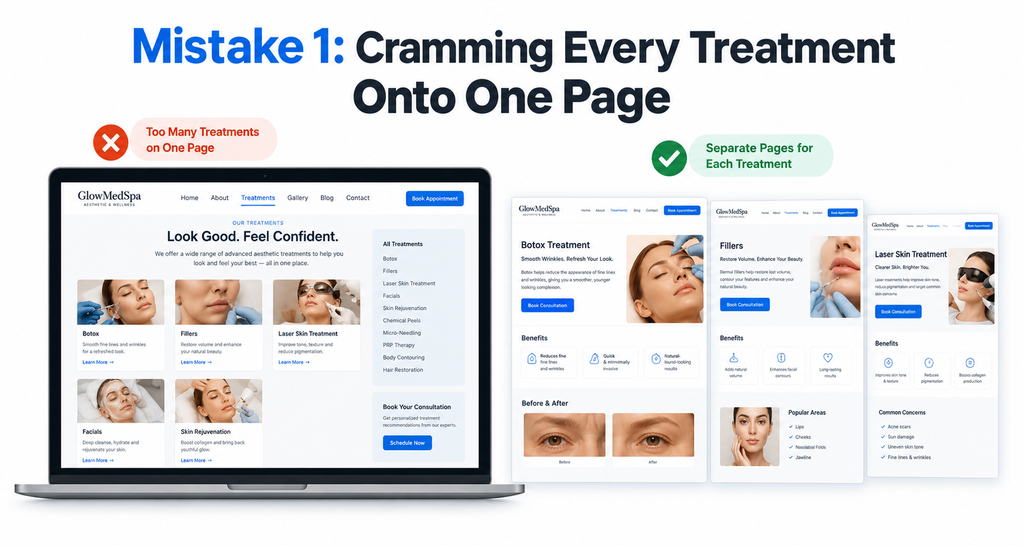
Why does it happens. Building one “Services” page feels efficient. One page, one update, done.
The real cost. Google cannot rank one page for Botox, filler, and laser hair removal at the same time. A single page competing for ten different treatments usually ranks well for none of them.
How to fix it: Give every treatment its own page. Include what the treatment is, who makes a good candidate, real recovery timelines, and honest before and after results. A strong SEO strategy for aesthetic clinics helps each treatment page target its own search intent.
A Botox page should link to your filler page. An acne treatment page should link to microneedling. One page trying to do everything usually ends up doing nothing well. Split it, and each page finally has a real shot.
Mistake 2: Picking Only One Google Business Profile Category
Why does it happens. Most clinics pick “Medical Spa” as their primary category and stop there.
The real cost. Google Business Profile allows secondary categories too. Skipping them means you stay invisible for services you actually offer, like laser hair removal or body contouring, simply because you never told Google you offer them.
How to fix it. Add every legitimate secondary category available. List every treatment as an individual service inside your profile, not just in a general description. This single change often surfaces a clinic in map pack searches it never appeared in before. Fixing your profile solves half the local visibility problem. The other half lives on your own site.
A strong local SEO strategy for medspa connects your Google Business Profile, location signals, reviews, and website content.
Mistake 3: Writing Location Pages That Say Nothing Specific
Why does it happens. A line like “proudly serving the greater Miami area” feels complete. It is not.
The real cost. Google rewards specific geographic relevance. A vague sentence tells Google almost nothing about which neighborhoods you actually serve or compete in.
How to fix it. Name the real neighborhoods, landmarks, and nearby areas your patients come from. Instead of “serving Miami,” write “serving Brickell, Coral Gables, and the greater Miami metro.”
This small change signals real local relevance instead of a copy paste template. Getting found locally means nothing if the page a patient lands on never earns their trust once they arrive.
Does Local SEO Matter for Med Spas and Dermatologists?
Yes, more than almost any other type of SEO for this industry. Patients search for these treatments close to home, not nationally. A clinic with a complete Google Business Profile and specific location pages usually beats a bigger, better known competitor that skipped both.
Mistake 4: Publishing Treatment Content With No Named Practitioner
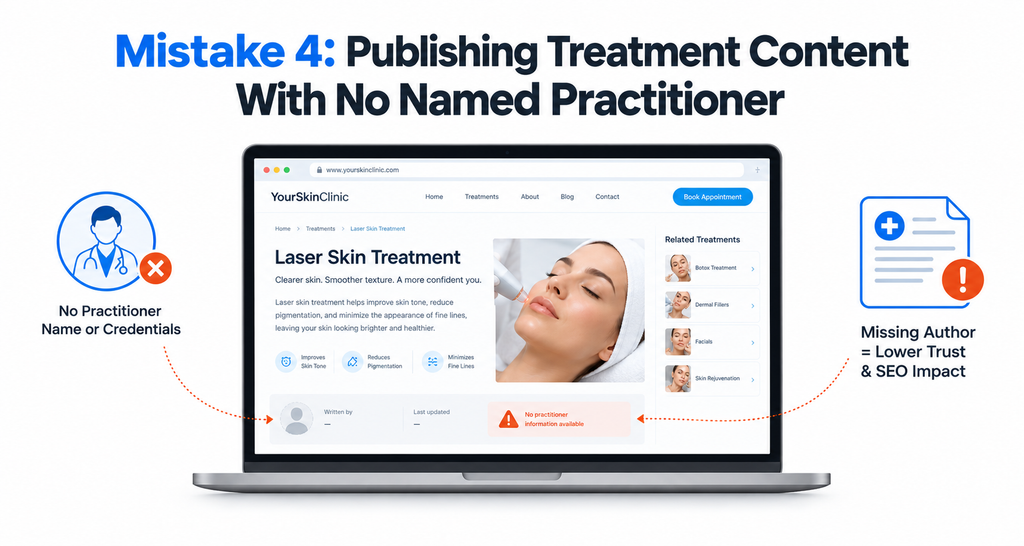
Here’s a most clinic blogs are written by nobody, reviewed by nobody, and it shows. Patients can tell.
Why does it happens. Writing feels faster without adding a bio, a credential, or a review step.
The real cost. Google treats medical content as YMYL, short for Your Money or Your Life. That means health related pages get extra scrutiny for trust and accuracy.
An anonymous page with no visible credential behind it struggles here, even if the writing is technically correct.
How to fix it. Attach a real name and license to every treatment page. Add a short bio. Have a licensed practitioner actually review the content before it publishes, not just proofread it for typos. This single habit is the fastest way to build the trust signals Google looks for in medical content.
Mistake 5: Ignoring Mobile Speed and Image Size
Why does it happens. A beautiful before and after gallery feels worth the file size. It usually is not, once it slows the page down.
The real cost. Most patients search from their phones. Google’s own research has found that a large share of mobile visitors leave a page that takes longer than three seconds to load.
A slow loading page loses that patient before they read a single word about your results.
How to fix it. Compress every image before upload. Rename image files with the actual treatment name instead of a generic camera file number, like botox-forehead-results.jpg instead of IMG4821.jpg.
Check your Core Web Vitals in Google Search Console every few months, since new plugins and bigger galleries quietly slow sites down over time. Both changes help load speed and give Google more context about what the image actually shows.
A fast page is not a nice extra. It is the difference between a booked consult and a closed tab.
Mistake 6: Writing Only for Old Fashioned Search
Why does it happens. Most SEO habits were built for a search results page full of blue links. That page barely exists anymore.
The real cost. Patients now ask ChatGPT and Google’s AI Overviews things like “what’s the best treatment for under eye hollows” instead of typing a normal search. Content that only targets old style rankings misses this shift entirely.
How to fix it. Structure your content with short, direct answers near the top of each page. Use clear FAQ sections with real questions patients actually ask.
These same habits that win a featured snippet are increasingly the habits that get quoted inside an AI generated answer too. Understanding how GEO and SEO work together can help businesses prepare for this shift.
Mistake 7: Mishandling Reviews
Why does it happens. Some clinics ask patients to include specific keywords in their reviews, thinking it helps rankings. Others simply ignore negative reviews and hope they disappear.
The real cost. Scripted reviews read as fake, because they often are, and review platforms are increasingly good at spotting the pattern.
Ignored negative reviews signal a clinic that does not respond to patient concerns, which hurts trust more than the original review ever did.
How to fix it. Ask for honest feedback instead of scripted phrases. Respond to every review, good or difficult, within 48 hours.
A calm, professional response to a negative review often builds more trust than a stack of five star reviews ever could. We cover the full review system in our med spa lead generation guide.
Mistake 8: Letting Business Listings Go Inconsistent
Why does it happens. A clinic moves suites, changes phone systems, or rebrands, and nobody updates every directory listing to match.
The real cost. Your name, address, and phone number need to match exactly everywhere they appear online. One outdated suite number on an old directory listing can quietly undercut months of otherwise solid SEO work.
How to fix it. Run a citation audit across Google, Yelp, Healthgrades, and any medical directories your clinic appears on. Consistent business information is a core part of local search optimization.
Mistake 9: Skipping Schema Markup
Why does it happens. Schema is code, not content, so it gets deprioritized behind writing and design.
The real cost. Without structured data like MedicalClinic, Physician, or FAQPage schema, Google has to guess at details your code could have stated plainly. Guessing rarely favors you.
How to fix it. Add the schema types that actually match your business, your practitioners, and your treatments. This is a one time technical fix that keeps paying off every time Google crawls your site again.
Getting the technical layer right means nothing if your pages never connect to each other once they are live.
Mistake 10: Weak Internal Linking Between Pages
Why does it happens. Most clinics publish a page and move on. Nobody goes back to link it to anything else on the site.
The real cost. Google finds and ranks pages partly by following links from other pages on your own site. A treatment page sitting with zero links pointing to it looks orphaned, and orphaned pages rarely rank well no matter how good the writing is.
How to fix it. Link every blog post back to the treatment page it discusses. For example, a dental practice can connect educational articles to its treatment pages using relevant SEO for dentists principles.
We can run a site audit to find orphaned pages and missing links.
Mistake 11: Publishing Thin, Generic Blog Content
Why does it happens. A quick five hundred word post feels like enough to check the box marked “we blog.”
The real cost. Short, generic posts that could belong to any clinic in any city rarely rank, and they rarely convert a reader into a patient either. Google increasingly rewards depth and real expertise over a high volume of shallow pages.
How to fix it. Write fewer posts, but make each one genuinely useful. Answer the actual question a patient typed into Google, with real detail, not a rehashed definition anyone could find on Wikipedia.
One strong, specific post about recovery timelines after filler will outperform five vague posts about general skincare tips.
Mistake 12: Never Tracking What Is Actually Working
Why does it happens. Between patients and daily operations, checking analytics feels like a task for later. Later rarely comes.
The real cost. Without tracking, you cannot tell which page brings in patients and which one is quietly doing nothing. Clinics often keep paying for the same broken strategy for months simply because nobody looked at the data.
How to fix it. Check Google Search Console and Google Analytics monthly, even for ten minutes. Look at which pages get clicks and which ones get bookings. Want to see how SEO improvements translate into measurable business outcomes? Explore RankSeoly’s SEO case studies for real examples of traffic and ranking growth.
All Twelve Mistakes at a Glance
We ranked these twelve by how often we see them during a first audit and how much visible ranking damage each one tends to cause. Use this as a quick reference, then go back to the section above for the full fix.
| Mistake | Real Cost | Fastest Fix |
| One page for every treatment | Splits ranking power across nothing | One dedicated page per treatment |
| Single Google Business category | Invisible for services you offer | Add every real secondary category |
| Vague location pages | Weak geographic relevance | Name real neighborhoods and landmarks |
| No named practitioner | Fails Google’s trust standard for health content | Add credentials and a review process |
| Slow, uncompressed images | Loses mobile patients before they read anything | Compress and rename every image |
| Old style search habits only | Missed in AI Overviews and voice search | Short answers, real FAQ sections |
| Scripted or ignored reviews | Reads as fake or feels neglectful | Ask honestly, respond within 48 hours |
| Inconsistent NAP listings | Quietly undercuts local rankings | Run a full citation audit |
| No schema markup | Google has to guess at your details | Add MedicalClinic and related schema |
| Weak internal linking | Pages look orphaned to Google | Link every post to a treatment page |
| Thin, generic blog content | Rarely ranks or converts readers | Fewer posts, real depth per post |
| No performance tracking | Keeps paying for what is not working | Check Search Console and GA4 monthly |
What SEO Issue Hurts Rankings the Most?
Thin, duplicated treatment pages usually do the most damage. When one page tries to rank for ten different services, Google cannot tell what the clinic actually specializes in, and rankings suffer across the board instead of just one page.
How Do I Know Which Mistake Is Hurting My Clinic Most?
Start with your Google Business Profile. If your categories and services are incomplete, fix that first, since it usually delivers the fastest visible change. Then check whether every treatment has its own page. Those two fixes alone resolve what we see most often.
Conclusion
Here’s what nobody tells you when they sell you a full website rebuild. Most clinics do not need one. None of these twelve mistakes are dramatic. That is exactly why they last so long. Nobody notices a missing schema tag the way they notice a broken website.
Fix even three of these this month, starting with your Google Business Profile categories and your treatment pages, and you will likely see movement before your next fill schedule rolls around.
Our medspa SEO tools guide covers exactly what to use to track the fixes. If you want a second set of eyes on which of these twelve is costing you the most patients, request a free SEO audit today and we will show you exactly where to start, before another competitor gets there first.
Frequently Asked Questions
How is SEO used in healthcare?
Healthcare SEO helps patients find providers through search engines. It involves optimizing treatment pages, local listings, and website performance. Accurate medical information, clear practitioner credentials, and expert review help establish trust.
How long does it take to fix these SEO mistakes?
Simple fixes, such as correcting listings or adding internal links, can take a few hours. Larger content and technical changes may take weeks. Ranking improvements take longer and depend on competition, crawling, and the scope of the changes.
Is it worth hiring an SEO company for a medspa?
Hiring an SEO company can be worthwhile if your medspa lacks time or expertise. Choose an agency that understands healthcare content, local search, and patient acquisition. Measure success through qualified inquiries and bookings alongside rankings and traffic.
What are some common SEO mistakes beginners should avoid?
Common medspa SEO mistakes include combining all treatments on one page, choosing inaccurate Google Business Profile categories, and publishing generic content. Beginners should also address mobile speed, inconsistent business details, missing practitioner credentials, weak internal links, and poor conversion tracking.
How do you fix SEO for an aesthetic clinic?
Audit your site for the twelve mistakes above, starting with your Google Business Profile and treatment pages. Fix the highest impact issues first. A clinic that fixes its GBP categories and adds dedicated treatment pages in the same week usually sees the fastest combined improvement in local visibility.


